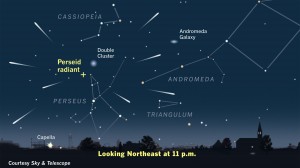
 The Perseus Meteor Shower, or the “Tears of St. Lawrence,” occur every year between late July and August and are known to produce views of 100 meteors in an hour. Of course to see near this number you will need two things in your favor.
One, a dark sky location with little light pollution – so you’ll have to leave that street light at the corner of your lot. Your neighbors will have to turn off their outside lights too.
Number two, you will need to have a fairly moonless night going into the morning hours. We have the moonless night, with the 24 day old moon rising at 2:21am. so the best remedy for any lighting issues near you, is to drive out and find a remote spot to watch the shower from. The Perseids are one shower that we look forward to every year due to its prolific show and with the moon pretty much out of the way, and 30% full, the early morning hours into Sunday should be a good show.
Most of the material that makes up this shower is debris from Comet 109P/Swift-Tuttle which was discovered in 1862. Between the years 1864 and 1866, noted Astronomer Schiaparelli performed computations examining the orbit of Swift-Tuttle and found a strong resemblance to the meteor shower. This was the first time a meteor shower had been positively identified as being the debris produced by a comet.
So what does St. Lawrence have to do with a meteor shower? St. Lawrence, a deacon of the Roman Church, was one of the many victims of persecution by the Roman Emperor Valerian. In 258AD, Valerian issued an edict that all bishops, priests, and deacons should be immediately put to death. On August 10th, St. Lawrence, the last of the seven deacons, was also put to death. St. Lawrence is the patron Saint of librarians, archivists, cooks – due to the way of his death, and deacons.
According to Folklore, one is to make a wish, or perhaps say a prayer when they see a falling star and it was better yet to make a wish and invoke St. Lawrence to pray along with you upon seeing the falling star. The falling stars of the Perseids, occurring around the same time as St. Lawrence Martyrdom, were looked upon as
his tears and Psalms 8. Domine, Dominus noster seemed appropriate to think of when watching the Tears of St. Lawrence.