By Donna Supitilov Skora
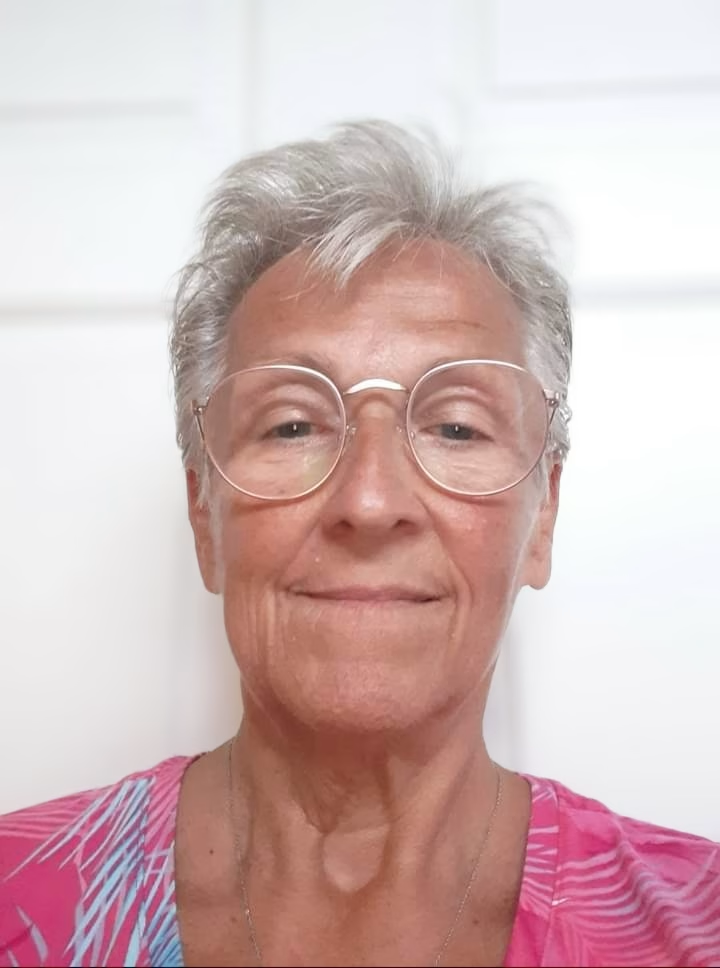
When her grandson was born, she imagined moments most grandparents quietly dream of—soft cheeks pressed to hers, first steps celebrated together, holidays wrapped in laughter. Instead, she was abruptly cut off by a text message: “You have lost a grandson, a son, and a nephew. Grandparents have no rights.”
Estrangement arrived without warning, leaving her grieving someone still alive.
Her daughter-in-law’s son from a previous marriage endured a decade of separation from his grandmother and father’s extended family. Witnessing the long-term impact revealed a deeper truth: this is a widespread, often invisible wound.
Grandparent alienation syndrome, increasingly recognized as a form of elder abuse, occurs when parents deliberately restrict or sever a child’s relationship with grandparents for no good reason. The damage cuts both ways: grandparents grieve, feel isolated, and question their worth, while children grow up confused, anxious, and deprived of the unconditional love, stability, and guidance grandparents uniquely provide.
According to a YouGov poll, 6% of American adults reported being estranged from a grandchild, and 9% from a grandparent (YouGov, “Family Estrangement: How Often and Why It Happens”).
Grief over the living is a quiet heartbreak—no funeral, no public acknowledgment, no rituals. Instead, there is silence, shame, and the ache of watching others enjoy relationships taken away. Many grandparents suffer alone.
Searching for answers, she discovered thousands quietly carrying the same pain, so she created a Facebook group, Surrogate Grandparents-USA.
What began as a place for comfort has grown into a national community.
Within this space, loss became purpose. Children found mentors, parents found encouragement, and grandparents rediscovered belonging.
A widowed grandmother in Texas now reads bedtime stories by video chat to a five-year-old in Ohio. A Florida family welcomed a local “grandpa” to teach fishing and life lessons. A shy boy proudly told his teacher, “I have two grandmas now.”
“I started this from heartbreak,” Donna reflects, “but it has grown into something far greater than I ever imagined.” Her story is a testament to resilience—the power to turn sorrow into service, loss into love, and isolation into connection. Even in the shadow of estrangement, hope can grow. If my grandson ever learns about me, I hope he’ll realize that his existence was the catalyst that turned loss into community.
Sometimes, family is built not by circumstance, but by choice.
Donna Supitilov Skora is a grandmother, writer, and advocate for families affected by grandparent estrangement. She shares her experiences to help others find hope, healing, and connection through difficult family dynamics.