In an effort to deter storm surge, Fort Myers Beach will soon begin construction on a nearly 7-mile-long emergency barrier that will protect the shoreline.
And while some locals whose properties outlasted the hurricane still tout the benefits of a seawall, they recognize three defense systems – walls, berms, and renourishment – as part of the overall solution.
But one seawall may have done more harm than good.
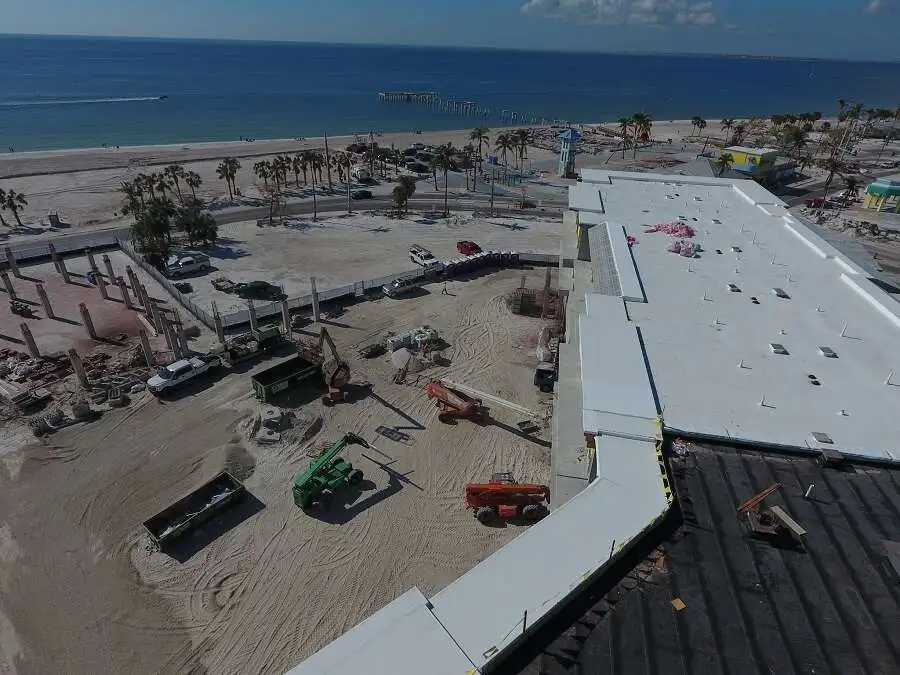
While the Margaritaville Resort under construction on Estero Island was protected from the storm surge, its neighbors, including all of Times Square, took horrible hits from the redirected saltwater, which washed out much of the older construction. Experts say that’s exactly what a seawall is supposed to do – and why they shouldn’t be used on barrier islands like Fort Myers Beach.
When Hurricane Ian hit Fort Myers Beach, the storm surge reached nearly 14 feet, according to United States Geological Survey data. It swept up much of the fine, white sand the town’s beaches are known for and redistributed it all over the island, according to town spokesperson Jennifer Dexter.
After months of sifting debris out of the recovered sand, the town hopes to return the clean sand to the beach the storm scoured, and use it to create an emergency berm. The sand berm will follow the natural rise in elevation from water to land.
After the sand is added back to the beach once the project starts this spring, the beach will stand 6-and-a-half feet above sea level, elevating the beach by approximately 1 to 2 feet. This should provide protection from storm surge, in accordance with current FEMA and Florida Department of Environ-mental Protection guidelines.
Also, the Estero Island Nourishment Project is set to start this fall. It will add about one million cubic yards of sand to the beach to increase the overall height and regain some footage that has been lost over the years with the goal of creating recreational space and protecting against future storm surges.
The project, primarily funded by the state and Lee County, was first permitted more than a year before Ian slammed into the island.
How one seawall may have led to the destruction around it
TPI Hospitality CEO Tom Torgerson credits a seawall built into the ground in front of Margaritaville with the site’s survival of Hurricane Ian.
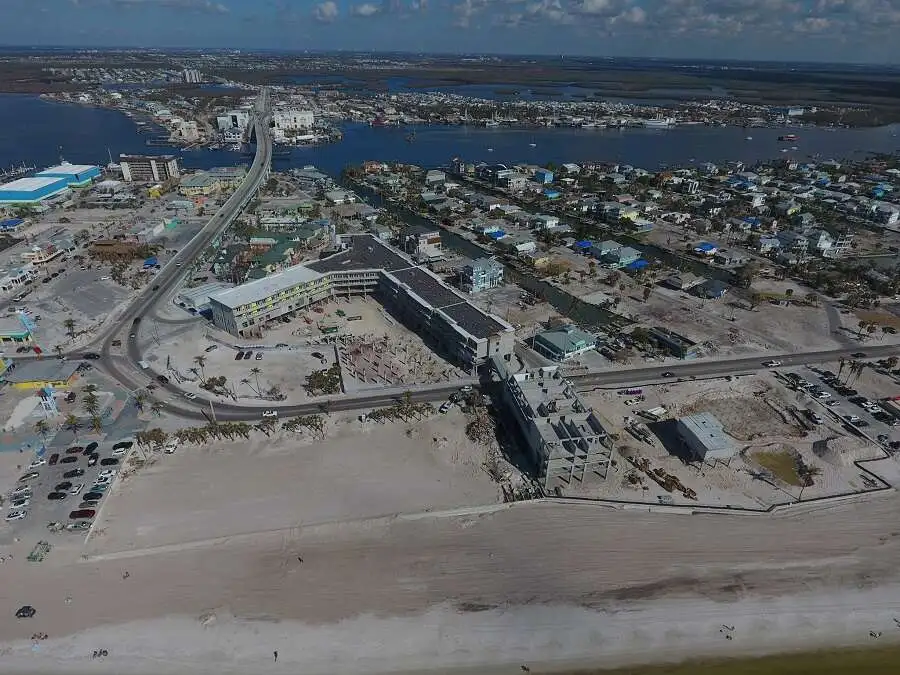
The storm surge scoured sand from both sides of the wall, “but it greatly disrupted the wave action,” Torgerson said. “If you look at the NOAA aerials posted there’s basically a moat on both sides of the wall.”
Margaritaville’s seawall was already built into the ground before TPI Hospitality purchased the property; Torgerson said TPI performed maintenance on it in 2017 and 2018. As a result, Torgerson said, it escaped much of the damage it might have endured had it not had a seawall.
“That significantly mitigated the damage we had to our construction project,” Torgerson said.
This isn’t the only seawall project connected to TPI –– in 2015 the town rejected a TPI proposal to implement a half-mile long seawall, which would have run from Shuckers north past Lynn Hall Park, extending beyond where TPI’s current seawall sits. The wall would have been sunk into the ground to prevent scour, with a sand cap tapering to the ground and a boardwalk constructed on top. “It would have been just like the one in Clearwater,” Torgerson said, “And that’s invisible to the residents.”
After pushback, however, TPI dropped the combination seawall-bordwalk proposal. Looking back, Torgerson said he thought it was just a case of “too much, too fast.”
While at the time that may have seemed shortsighted to some, today experts say it was the right move. Although seawalls may save one property from storm surge, research shows they redirect the destruction to areas that sit outside the seawall’s protection, exacerbating flooding and its associated damages to lives, property and the environment.
According to an article in scientific journal PNAS, individual seawalls can wreak havoc on the areas around the seawalls, amplifying flooding and damages in zones not located behind a seawall. In fact, barriers as small as 3.1miles long can increase flooding in other areas by as much as 36 million meters cubed, and damages by $723 million for a single flood.
The NOAA imagery collected in the days following Hurricane Ian shows a devastated Fort Myers Beach. Search out Margaritaville, though, and you see the faint line of the seawall, and beyond that, a fairly intact building.
Examine the seawall closely and you’ll see where the sand caved to the water, where storm surge scoured sand from the edges of the seawall and rushed onto the island, pouring through Times Square, through Shuckers, the Beacon Motel, Pierside Grill and The Whale –– all situated just north or just south of Margaritaville’s seawall.
All closed now. Some for good. Some are completely gone. “That’s what seawalls do,” said Cheryl Hapke, a senior coastal resilience scientist with Integral Consulting and research professor at the University of South Florida. Hapke studied beach evolution and morphology in the North-east and Florida for the U.S. Geological Survey for 22 years, spending her career barrier islands. “It sacrificed the beach to prevent the waves from overtopping and moving inland.”
This, Hapke said, is why towns like Fort Lauderdale require them of every beachfront property owner: one seawall protects only one property but magnifies the damage for those on either side of it. If just one beachfront resident has a seawall, she said, everyone needs to have one to escape the impact.
Examining the NOAA imagery, Hapke noted that Times Square likely had waves breaking on the structures themselves. The buildings were older, lower and quaint. She said Margaritaville stood a better chance to survive not just because of the seawall in front of it, but because “my hunch is, it’s a much newer and more robustly-built building” compliant with updated codes.
University of South Florida coastal geology professor Ping Wang agreed, adding that before and after photos of the area show there was comparatively little beach in front of the seawall to dissipate the incoming waves, leading to scour around the base of the seawall.
Still, Torgerson remains a proponent of seawalls, having seen firsthand how it protected Margaritaville during Ian. “The seawall isn’t a real factor other than it protects property,” he said.
A berm, not a wall, is the way forward
Coastal engineers, architects and scientists say Florida’s porous limestone base and the shifting sands of the barrier islands like Fort Myers Beach, Sanibel and Captiva demand a softer edge than a seawall. Unlike a seawall, a sand berm won’t trap water, cause erosion or shift currents or storm surge damage to neighbors.
Hapke said that the natural response of barrier islands to the waters from storms and sea level rise is to move landward, its sands pushed back foot by foot over the years. This movement allows them to maintain their function and elevation. But “when you build seawalls you’re locking it in place,” and creating different problems.
“Seawalls are problematic,” she said. “Any storm is going to erode (the beach) back to that seawall, and then you can have scouring out.
“If you put a seawall on that island, the implication is you’re going to lose the beach in front of it,” she continued. “Then you lose your tourist base. Then your ecosystem –– there’s dunes, critters that live in the dunes, the rack line on the beach and shorebirds that feed off the critters that live in that rack. You have to think of it as a whole ecosystem over someone’s desire to protect that one property.”
Torgerson has heard all this before, he said. He’s gone “toe to toe” with scientists, and he strongly believes seawalls are important to protect property and allow people to live in places like Fort Myers Beach, Key West and New Orleans. The fact that he saw significant scour around his Margaritaville seawall doesn’t deter him –– it’s all part of the process of maintaining beachfront property.
Torgerson, who was supportive of the emergency sand berm, said he doesn’t think it will encroach on the view looking north and south on the beach. He continued on to say it’s important not to be intimidated by the 6and-a half-feet height of the berm. “One,” he said, “it’s not really that high because it’s set back from the water and the beach already rises (the farther you get) away from the water.
“And two,” he continued, “The beach nourishment program will work nicely in conjunction with the FEMA berm. It will elevate the height of the beach to the height of the berm, and just taper it right down to the water. It won’t look like a pile of sand; it’ll look like a beach.”
Pink Shell Resort & Marina operator Bill Waichulis is also in favor of the berm –– he sees it not only as good for the local economy and infrastructure, but good for wildlife, too.
“I’ve never seen this done before, so I’d be curious where else (this has been done), but anything that would help with storm surge would be good,” Waichulis said. “If you ask anybody traveling to Lee County, the number one reason they come here is for the beaches, so anything we can do to keep them pristine and full of sand is vital to our economy.
“Beside that,” he added, “The less sand we have on the beach, the less places (sea turtles) have to lay eggs.”
Experts say renourishment is a short-term solution
The town estimates the sand berm will cost $7.2 million, and the beach nourishment project will cost just under $25.5 million.
Dexter said the town expects FEMA to cover 75% of the cost of the sand berm, and the state will cover the local cost associated with it. Fort Myers Beach’s only expense is the pre-Ian design of the Estero Island Nourishment Project, which cost $931,648.
Once FEMA has confirmed funding and the town has approved a contractor bid, the town will begin its emergency berm construction. Fort Myers Beach has also requested funding from the Florida Department of Environmental Protection for emergency work.
According to the town website, the berm project will likely involve trucks hauling mined, beach-compatible sand and will take between three and four months to complete.
While the town is currently not on the hook for any of the costs to build the berm, that may not always be the case, Fort Myers Beach Mayor Dan Allers said. Still, the berm is worth building, he said.
“I think without this emergency berm … we obviously open ourselves up to more significant damage, should another event happen,” Allers said. “Even though it’s six-and-a-half feet above the water level, in some cases it’s only a foot or two of sand. That foot will help protect against another Ian.”
Hapke noted that while beach nourishment makes residents feel too safe in the face of sea level rise and climate change, the nourishment project is needed to take place in order to protect Estero Island against even just the upcoming storm season. “The beaches are so eroded, low and damaged that if we didn’t renourish them and another even decent storm came next year, the devastation would be horrible,” she said. “A wide beach is sacrificial to protect your dune system.”
She noted that in other parts of the world, such as Goa, India, coastal residents live in temporary housing and relocate away from the coast when it’s too dangerous to stay.
That type of seasonal living might be an option for people who want to live on Florida’s coast or its barrier islands in the future, she said.
“Ultimately, it won’t be economically viable to continue to renourish,” she said. “Sand is not a renewable resource.
“For now, everyone needs to buy some time and feel safe, but the community is going to have to think down the road 30, 40, 50 years. Renourishment is not always going to be an option,” Hapke said.
But Torgerson isn’t having it. Beach renourishment is part of the maintenance process, he said, he’s glad Fort Myers Beach is carrying that out.
“The majority of the island needs re-nourishment, whether they need a seawall or not,” Torgerson said.
What should we do, he asked, evict everyone from Fort Myers Beach? Leave the entire island to nature and just watch it for the next five decades? The renourishment, the seawall, the berm, all this is done to sustain life on Fort Myers Beach, he said.
“Isn’t that a great goal?”
Fort Myers Beach Mayor Dan Allers speaks during the topping-off ceremony for Margaritaville on Fort Myers Beach on Jan. 20. It is unknown when the resort will be finished.