Special to Lehigh Acres Gazette
During the few months that makeup Florida’s rainy season, awareness of the area’s water quality, storm water storage and hurricane preparedness is a priority.
However, agencies like the Lehigh Acres Municipal Services Improvement District work diligently year-round to plan, prepare and implement projects to alleviate storm water issues and educate the communities they serve.
“It is important for residents to realize that our waterways, canals, lakes, et cetra, are connected to larger bodies of water such as the Orange and Caloosahatchee Rivers, as well as Hickey and Bedman Creek,” said David Lindsay, LA-MSID district manager.
The fresh-water discharges from Lake Okeechobee can cause a variety of issues on the Caloosahatchee such as increasing the potential for algae blooms and can negatively impact both plant and animal life, noted LA-MSID Chairman Ken Thompson.
The LA-MSID provides flood control, conservation and mitigation, irrigation, navigation, roads/bridges and limited parks services to Lehigh Acres and western Hendry County – about a 110 square-mile area.
The LA-MSID’s 311 miles of canals serve a purpose, which, over time, has evolved to include flood and drainage control, water quality and water conservation, amongst other duties.
Another contributing factor to poor water quality is point-source pollution, or pollution caused by people, which can have a ripple effect in other communities. Dumping oil, trash and other such items in the waterways are not only acts punishable by law, but are harmful to the environment.
The district diligently looks for polluting sources in local waterways. In addition, it closely monitors the waterways as ultimately the system affects the Orange River and Caloosahatchee.
In an active rainy season, the focus expands to include storm water storage.
For years, the district has been working to chip away at its 15,000 acre-foot storage deficit using an in-house crew to replace critical culverts and special projects, securing grants and formulating partnerships with local government and state agencies, said LA-MSID Vice Chairman.
Culvert, weir replacement
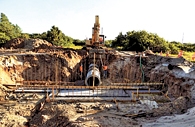
Culverts and weirs help to provide flood protection to the residents of Lehigh and their downstream neighbors. A culvert is a structure that allows water to flow under a road, whereas a weir is a structure built across a waterbody to adjust the level of water or regulate its flow.
“Properly working water control structures are crucial to our canal system because they regulate storm water levels and flows to each of the district’s outfalls into the Caloosahatchee,” said LA-MSID Commissioner Nathan Stout.
Critical weir replacement is essential in raising canal levels and they are part of the East County Aquifer Recharge Program. The program began in 1995 when the district, Lee County and the South Florida Water Management District conducted a study to determine the benefits of raising canal levels to promote groundwater recharge; this weir replacement is the fourth construction phase to the program.
When the program began, temporary concrete blocks were placed on structures to increase canal levels. The current project replaces these weirs with permanent structures capable of regulating water levels and providing both flood and drainage control.
These replacement weirs help the district more effectively store storm water and connect to underutilized portions of the district, thus ultimately reducing the freshwater discharges to the Caloosahatchee River, said Lindsay. LA-MSID has replaced 26 ailing, antiquated weirs over the last 15 years.
Treatment, restoring historic flows
This year, due to extremely high rainfall across the SFWMD, the Caloosahatchee experienced higher than normal discharges from Lake Okeechobee.
The district’s “Moving Water South Project Phase I: Halfway Pond Rehydration Project” has diverted 1,300 acre feet of storm water destined for the Caloosahatchee to Halfway Pond and is anticipated to surpass 2,000 acre feet this year if rain continues, said LA-MSID Assistant District Manager Michael Cook.
An acre foot is one foot of water that covers one acre; 1,000 acre feet are equivalent to 326 million gallons of water.
“Phase I was completed in October of 2012 with the aid of a $340,000 grant from South Florida Water Management District,” said Thompson. “Since its completion, this project has been able to store an average of 1,500 acre feet of storm water annually, lessening the freshwater impacts on the Caloosahatchee.”
The Halfway Pond Rehydration Project is the first of three phases to provide water quality, increased storage and restore historical flows to the southern part of the district, said LA-MSID Commissioner David Deetscreek.
It transformed Halfway Pond from its former state as sandy area choked off from the stormwater system and wrecked by ATV traffic to a restored and functional wetland.
Halfway Pond is located between Homestead Road and Alabama Road, just south of Milwaukee Boulevard.
Design work for Phase II should begin in the next six months, noted Lindsay.
Southwest Lehigh Weirs construction
In May, LA-MSID broke ground on the Southwest Lehigh Weirs project, otherwise known as the Aquifer Benefit and Storage for the Orange River Basin project.
The project provides construction of 25 weirs in Lehigh through a strategic, multi-agency partnership with the Florida Department of Transportation, SFWMD, Florida Department of Environmental Protection and LA-MSID. The project area is roughly between Sunshine Boulevard and Gunnery Road, north of State Road 82 and south of Lee Blvd.
In the project, an additional 700 acre feet of water will be stored and its nutrients and pollution will be removed from the Orange River and Caloosahatchee, said Lindsay.
Homestead weir
Through agreements with Lee County, LA-MSID received nearly $389,000 to replace an existing structure, Amberwood and 57-4-6, and to allow Lee to discharge storm water into LA-MSID’s system as part of the Homestead Road widening effort.
The project eliminated the need for a road side retention pond and allowed for increased storage, and the replacement of an older structure. Construction for the replacement weir is underway.
The location is north of Sunrise Boulevard and east of Richmond Avenue South.
Capital projects
In the next few years, LA-MSID will see several of its capital projects break ground due to government grants and partnerships, said LA-MSID Commissioner Michael Bonacolta.
LA-MSID identified and secured alternative revenue sources such as the sale of easements to the FDOT for $3.2 million. The project with FDOT allows for the construction of SR 82 to move forward without the need for road-side retention ponds, instead the project will drain to LA-MSID’s stormwater system. The funds from FDOT are earmarked for capital projects.
The agreement now allows the widening of SR 82 to move at a faster pace and answering the public’s demand for multi-laning SR 82 and saving lives.
In 2017, LA-MSID will see the construction begin on its long awaited West Marsh Project – part of the Buckingham Army Airfield during World War II.
The West Marsh is a 200-acre parcel that was mostly disturbed – with approximately 50 acres of intact wetlands and uplands to be preserved. It is adjacent to Harns Marsh – a 578-acre stormwater treatment area.
The property was purchased in 2008 by Lee County 20/20 and marked a cooperative effort between Lee and LA-MSID to revitalize the water storage within LA-MSID boundaries.
A memorandum of understanding was signed by both agencies providing LA-MSID with the authority to construct a 150-acre filter marsh that will provide quality water treatment for the 60 square miles on the west side of Lehigh as water flows from Abel Canal to Harns Marsh, into the West Marsh and then through the Orange River to the Caloosahatchee.
The project construction has been shovel ready for a number of years, but has been waiting for funding, noted Lindsay. The construction of the West Marsh will begin simultaneously with FDOT’s widening of SR 82 as dirt for the road bed will be provided by the West Marsh construction.
Harns Marsh holds 2,000 acre-feet of stormwater and the West Marsh Project can provide an extra 1,000 acre-feet of storage.
GS-10 Caloosahatchee Cross Link project
LA-MSID has been a project partner on several district-supported projects in the Caloosahatchee watershed, most notably, the Harns Marsh and Halfway Pond water storage projects.
LA-MSID is the project sponsor for the proposed GS-10 Caloosahatchee Cross Link project – a regional, multi-agency initiative to provide water storage and treatment within the Caloosahatchee watershed.
The project involves the acquisition and development of a former mine area, known as Section 10, into a shallow reservoir while creating a flow way to the Greenbriar Swamp that would be used for water treatment while restoring hydro periods within the natural system. It establishes connections between Lee County-owned lands and LA-MSID drainage system, which has multiple outfalls to the Caloosahatchee.
The GS-10 Caloosahatchee Cross Link project is a stand-alone regional initiative that may also serve as a water quality treatment component for the C-43 Reservoir by taking discharge water released from the Reservoir and flowing it through the LA-MSID treatment system before final outfall to the Caloosahatchee.
Benefits of the project include the addition of over 600 2,000 acre-feet/year of storage and the estimated nutrient reduction of 114-pound TP/yr. and 1,200 lb. TN/yr. Additionally, the project would improve flood control in a rapidly developing urban area, restore a degraded natural system and enhance wildlife habitat.
The project will assist LA-MSID and Lee County in meeting their assigned TMDL/BMAP water quality requirements.
The project is supported by State Rep. Matt Caldwell and State Sen. Elizabeth Benacquisto, who hosted a public forum in August 2015 to discuss the project.
A preliminary engineering analysis will serve to evaluate the feasibility and effectiveness of utilizing Greenbriar Swamp and the LA-MSID water management system as a water quality component for Section 10.
Lehigh residents should be aware that LA-MSID is but one governmental service organization that has a long history of doing its part regarding water quality in our waterways, noted Welch. Through hard work, focusing on the mission, respect for tax-payer resources and mutual cooperation with local and state governments, LA-MSID serves as a model for government action at all levels in addressing this crisis our area faces today.
The work has been accomplished without an increase of assessments for the last eight years.