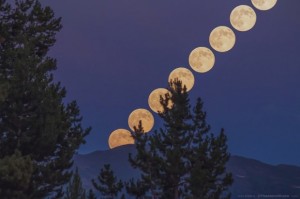
 Today’s weather pattern should allow for decent viewing of the “supermoon” tonight in Southwest Florida.
Tonight’s supermoon will shine brightly in the night sky on Sunday and marks the second of three such full moons for the summer — but there is another reason to take note of the event. In terms of timing, August’s full moon will occur within the hour the moon reaches perigee or its closest point to Earth.
Whether it’s the “super” or “mega supermoon,” the tonight’s full moon will delight viewers. The moon is an elliptical orbit around Earth which means there is a closest point, perigee, and a farthest point, apogee. At perigee, the moon is around 222,000 miles from Earth and at apogee the moon is around 252,657 miles away. For those asking what is a supermoon, it’s when a full moon occurs during perigee as it could appear 30 brighter and 14 percent larger than a regular full moon.
A supermoon is also a rather common event and the trio of supermoons this summer as last year had supermoons in May, June and July. As for why the August supermoon is better than the one in July or the upcoming one in September, the moon turns fulls within the hour the moon reaches perigee while the moon turns full on the same day as perigee in July and September.
The August full moon is also known as the sturgeon moon as fishing tribes caught plenty of these fish in large lakes.
As we marvel at the supermoon on Sunday, the brightness of the full moon will play a factor in the other August astronomy event; the Perseid meteor shower. The Perseids is perhaps the best meteor shower of the year, as it averages a high number of meteors per hour and plenty of fireballs, fast meteors that burn bright in the night sky. The waning gibbous will brighten the night sky, blocking out the dimmer meteors but the Perseids average around 30 to 40 meteors at its peak. The next supermoon occurs on Sept. 9.