Special to the Lehigh Acres Gazette
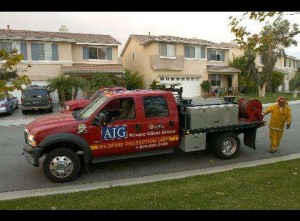 Private firefighting is a rapidly growing industry. Yes, private firefighters make up just 4.3 percent of the nation’s total firefighters, but this is an industry on the verge of catching fire because of a growing trend toward privatization.
According to a 2012 study conducted by market research firm IBISWorld, there are 256 private firefighting companies in the United States — a number that’s expected to grow to more than 320 by 2017. At the same time, the number of firefighters employed by private companies will increase from 16,880 to 27,206.
There was been increased privatization of firefighting efforts by state and local governments as those institutions have struggled with the decline in tax revenue, stressed budgets and caused consolidation of publicly funded fire suppression resources. Between 2009 and 2011, the number of public sector firefighters and first-line supervisors — structural and wildland fire — decreased by 0.6 percent. Over that same period, private sector firefighters and supervisors grew 16.9 percent, according to the Bureau of Labor Statistics.
Privatization of firefighting saves most state and municipal governments between 10 and 40 percent, according to a 2012 study by Ibis World, “Private Firefighting Studies In the U.S.”
Private contract resources — national and regional 20-person firefighting crews, engines, dozers, tenders and other specialized equipment, and support services such as caterers and shower/handwashing units— afford government agencies the flexibility to bring in additional resources only when needed. This is a more cost-effective solution. Furthermore, the costs of training, insurance, benefits, gear and transportation costs are all borne by the contractor.
Insurance companies are increasingly hiring private crews for both preventative and emergency services. They have private firefighters pre-treat insured properties, and they will also call them in to help fight fires around an insured property.
The National Wildfire Suppression Association (NWSA) is the leading organization for private wildland firefighters. The association represents more than 150 private sector contract companies in 16 states. All together, these companies can field a work force of about 12,000 people if needed. Member companies comply with government standards and honor both Federal and State procurement and dispatch procedures.
In a recent press release, the NWSA touted the private wildland firefighting industry, saying, “Braving the smoke, heat, and danger of wildfires or the aftermath of disaster are federal, state and local responders. When the magnitude of the event exceeds the current agency resources, they can call in “army” of professional private wildland fire contractors who bear all the costs of training, equipment, travel and other costs. The role of the private sector firefighting community is to be another tool in the agencies toolbox to pull out when they need assistance. We have shared the feeling of accomplishment in successfully suppressing fires, and also the feeling of sacrifice when we lose a brother or a sister on the line.”
And it’s not just boots on the ground.
Private firefighting companies play a large role of the firefighters on the ground — and have been huge in support of fire suppression efforts in western states in 2013.
The Rim Fire, the largest wildfire in the lower 48 states this year, saw privately operated aerial firefighting companies deploy their aircraft to the site of the fire in California’s Tuolumne County and Yosemite National Park.
“We have been on the Rim Fire since it began,” Robin Rogers, Vice-President of Fresno-based Rogers Helicopters, said in a news release. Rogers Helicopters had two Bell 212s dropping water from external buckets, and an AC 690 fixed wing and a Rockwell Twin Commander turboprop working initial attack, command and control aircraft. The helicopters were being flown under U.S. Forest Service (USFS) exclusive-use contracts.
A Sikorsky S-61, operated by Construction Helicopters, was dispatched to the Rim Fire under a USFS call-when-needed contract — and had just finished a firefighting job in Oregon when it was reassigned to California. Neptune Aviation Services flew fire retardant dropping missions from the Rim Fire’s start, initially with two of its P2V Neptune fixed wing tankers, then added a third at the request of the Forest Service, which has the three air tankers under an exclusive-use contract.
Construction Helicopters, Neptune Aviation Services, and Rogers Helicopters are members of the American Helicopter Services and Aerial Firefighting Association (AHSAFA), the Washington, D.C.-based trade association representing the commercial operators of helicopters and fixed wing aircraft engaged in aerial wildland firefighting.
There could be several options that the Community chooses and should be by Democratic Process. The Fire Board has an appearance of ignoring the financial warnings of the past and now the Community finds itself possibly paying 30% higher rates for the Board Not paying attention.
State will not allow default of the existing Fire District therefore the following are prominent possibilities
1. (HIGH PROBABILITY) State could take over operations
2. (MEDIUM PROBABILITY) Merge with adjacent Fire Districts
3. (SLIM CHANCE) Loose certifications as primary Fire Protection for Lehigh and then Insurance companies will have the excuse to raise everyone’s Home Owners insurance.
Hopefully now our Board is paying attention
Thank you Matt Smith. My heart is heavy when I read about the condition of our Public Safety in Lee County.