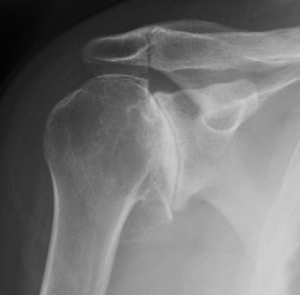
 This month I’d like to discuss the Shoulder joint and Rotator Cuff disease. The shoulder is complex ball and socket joint. It is the most mobile joint in the body. Because of this mobility it is subject to many different forces and makes it more susceptible to injury or damage. The most common problem that I see in our southwest Florida population is problems with the Rotator Cuff. The Rotator Cuff is a group of four muscle-tendon units that surround the shoulder. They provide the joint with dynamic stability so that the ball stays centered within the socket thus allowing full range of motion.
The Rotator Cuff begins to show degenerative changes as we age. Most people hear of the stories related to athletes sustaining tears. This however is not the case. The most common cause of Rotator Cuff disease is age related degeneration. As we age past 50 the Cuff begins losing some of its blood supply. Because of this it loses it’s ability to repair itself of the daily wear and tear to which it is subjected. Also, this tissue is sandwiched between an archway of bony structures that change with age causing impingement from bone spurs that happen to many of us with age.
It is important to understand that as we get older we need to keep the shoulder healthy. Common signs of Rotator Cuff disease are shoulder pain at night. Pain reaching above shoulder level and/or behind the back. Weakness with arm elevation coupled with pain is also common. Stretching and strengthening is an important part of maintaining Rotator Cuff health. There are many great instructional videos that can be seen on the Internet. They are simple exercises with very low weights that I would recommend as a means of injury prevention. This is the first line for preserving shoulder health. If the Cuff does become diseased, exercise and rehabilitation are also important to restoring its health. If this does not work, then we as joint specialists can assist. Usually, the addition of a topical or oral anti-inflammatory medication coupled with a cortisone injection will remedy the problem. Lastly, surgery is the ultimate option if all else fails. Ninety-five percent of patients in my practice who fail non operative treatment can be cured with an outpatient arthroscopic surgery. This avoids large incisions thus decreasing pain, making recovery more tolerable. As an orthopedic physician, the shoulder is a joint that fascinates me. It is extremely rewarding to see the passion that people put into their recovery and ultimately at the end of the journey returning to their everyday and recreational activities. Call us or email us if you need more direction. Remember that about 80% of your shoulder pain can be treated without surgery.
Peter Curcione D.O.
drcurcione@bone-fix.com
www.bone-fix.com
Ph. 239-368-8277